
Winter advice
Old wasp nest in the loft? How to take it down safely this winter
An empty wasp nest is harmless, and wasps won't use it again. If you'd still rather it went, winter is the time. Here's how to check it's finished and take it down properly.
By the Wasp Nest Removal Hertfordshire team · · 5 min read
Home / Wasp season blog / Removing an old nest
The short version
- Wasps never move back into an old nest. Once it's dead, it's an empty paper shell.
- This year's season ran late, so give a nest a few weeks of cold weather and no traffic at all before you touch it.
- If you do take it down, wear gloves and a dust mask, especially if it was treated, and bag it before it crumbles.
- Nests in wall cavities or under roof tiles are best left where they are. Seal the entry gap instead.
In this article
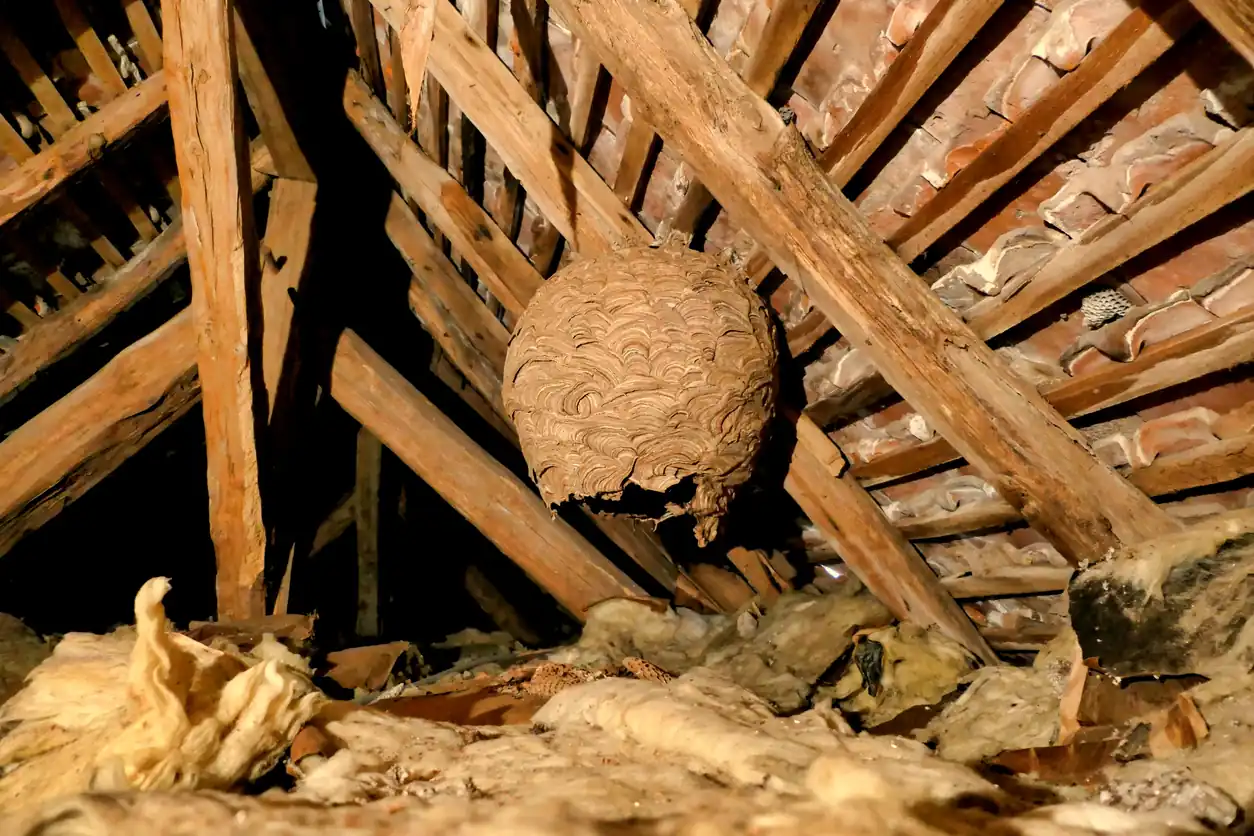
Winter is when people find old wasp nests. You go up for the Christmas decorations, or clear out the shed, and there it is: a papery grey ball the size of a football, hanging from a rafter. The usual first thought is whether it's safe to be near it. The second is whether it has to go.
The short answer: an empty nest is harmless, and you don't have to remove it. If you'd rather it went, winter is the right time to do it yourself. You just need to be sure it's finished first, and handle it properly.
First, make sure it's really finished
Every colony dies in autumn apart from the new queens, who leave to spend the winter somewhere else. Oxford City Council's advice is that nests die off completely once there have been some heavy frosts. A nest you find between January and April is, as Eastleigh Borough Council puts it, almost certainly last year's.
Early November is a bit different, especially this year. The warm autumn kept colonies going, and we were still treating live nests in the last week of October. So don't assume. Check it like this:
- Watch the entry gap on a mild, dry afternoon. That's when any surviving wasps would be flying. Give it 15 minutes.
- Look and listen at the nest itself, from a distance. No wasps on the outside, no humming.
- Repeat over a couple of weeks, ideally after a few frosty nights. If it's been silent every time, it's done.
If you still see a steady stream of wasps going in and out, leave it alone for now. It will finish on its own as the weather turns, and if it's somewhere awkward like above a door, ring us.
Do you need to remove it at all?
No. Wasps never go back into an old nest. Council pest control teams are consistent about this: each spring's queen builds a fresh one. Our guide to leaving a wasp nest covers the few practical reasons to take one down, such as a nest sitting on loft insulation for years and holding damp.
Where the nest is makes most of the decision for you.
| Where the nest is | Our advice |
|---|---|
| Hanging from a loft rafter | Fine to remove once it's dead, if it's in the way or near stored things. |
| In a shed, garage or summer house | Easy to remove. Usually the simplest job of all. |
| Inside a wall cavity or air brick | Leave it. You'd have to open up the wall to reach it, and it does no harm in there. |
| Under roof tiles or behind a soffit | Leave it. Don't lift tiles or boards to get at an empty nest. |
| Underground in the lawn | Leave it. Outdoor nests mostly fall apart by spring. |
How to take it down
Pick a cold, dry day, when anything left inside is as inactive as it will get. Then:
- Cover up. Gloves, long sleeves and a simple dust mask. Old nests are dry and dusty, and they crumble.
- Get a strong bin bag over it from below, so the whole nest is inside. Eastleigh's council advice is to then knock it gently with a broom so it drops into the bag.
- Ease it off the timber through the bag if it's still attached. Most nests are fixed on by a small area at the top and come away without much effort.
- Tie the bag and put it in your household rubbish.
- Clear up the bits underneath with a vacuum cleaner, and check the insulation beneath is dry.
If the nest was treated
If a pest controller treated it, assume there's insecticide powder in and around the nest and the entry gap. Stroud District Council's guidance is to avoid contact and wash any off your skin straight away. Keep children and pets out of the way, keep your gloves and mask on, and don't put a treated nest on the compost heap or the bonfire. If any live wasps appear when you disturb it, stop, close the hatch and leave it for a few more weeks.
The part that actually helps next year
Taking the nest down tidies the loft. It doesn't stop wasps. What does help is the gap they used to get in, which a new queen may find again in spring. Once you're certain the colony is dead, find that gap from the outside, usually at the eaves, a soffit board or a lifted tile, and get it sealed. Our prevention guide covers what's worth doing.
While you're up there, you might spot one or two large, sluggish wasps tucked into a corner or a fold of stored fabric. These are new queens. Tendring District Council notes that queens spend the winter in dry, protected spots such as sheds. A single queen isn't a sign that the old nest is alive, and she won't move back into it. You can leave her be.
What we're telling customers
If the nest has been quiet for a few weeks and it's somewhere you can reach easily, you don't need us. Bag it, bin it and seal the gap. If you're not sure it's finished, send us a photo or a short video of the entry gap on WhatsApp and we'll tell you honestly whether it's worth worrying about.
We cover the whole county, from Watford and Hertford to Stevenage and beyond. If you've found a nest in your loft this winter and you're not sure what you're looking at, ring us on 01727 789571. Most of these questions can be sorted out on the phone, and if it's just an old nest, we'll say so. For more on what a live loft nest looks like, see our loft nest guide.
Questions we get asked
Will wasps come back to an old nest next spring?+
Is an old wasp nest dangerous?+
Can I just leave it where it is?+
I found one big, slow wasp near the old nest. Is it still alive?+
Is it worth paying to treat a nest in November?+
Related guides
- What happens if you leave a wasp nest? – Month by month, and when leaving it is the right call.
- Wasp nest in your loft – Signs, risks and how we treat a live loft nest from outside.
- Prevention guide – Which gaps to seal over winter, and how.
Local to you