
Species Guide
European Hornet (Vespa crabro)
Britain's largest social wasp — and one of the most misunderstood. Big, loud, night-flying, but markedly less aggressive than a common wasp. This guide covers identification, nesting habits, and what to do if you find a hornet nest on your property.
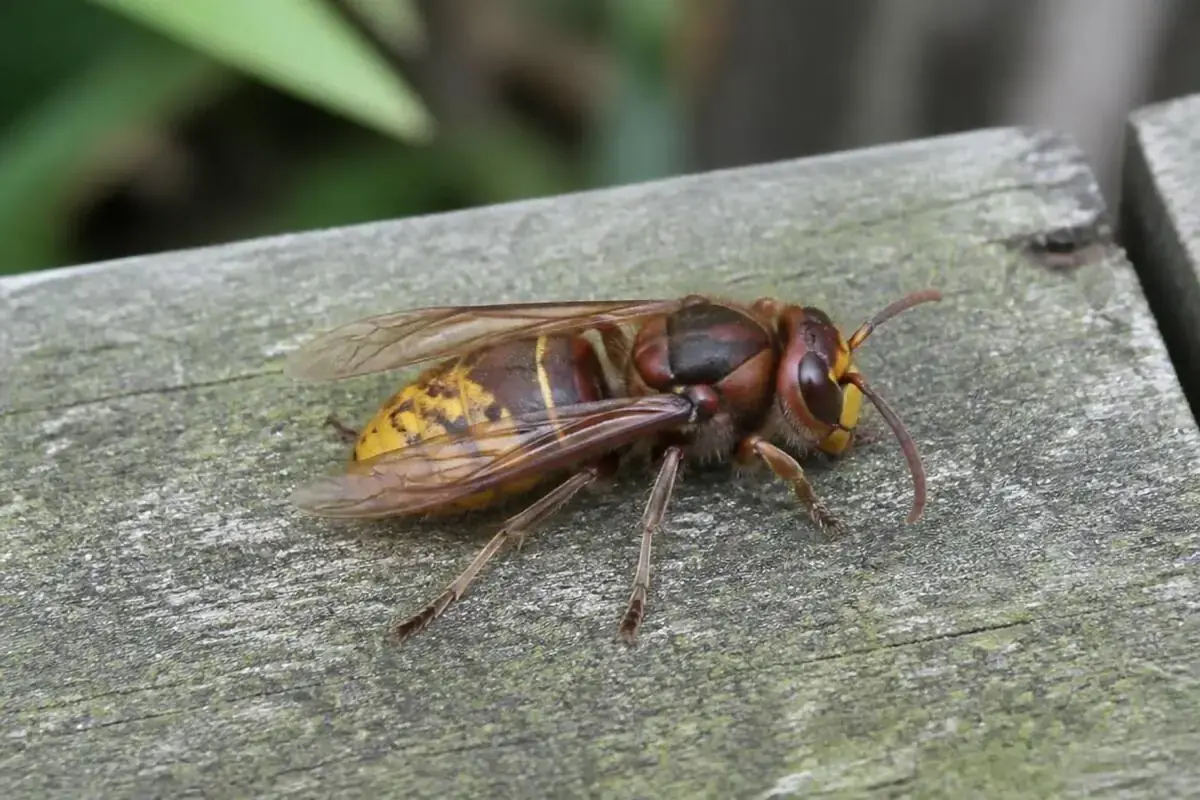
The European hornet (Vespa crabro) is the UK's only native true hornet. It has been here for centuries, plays a valuable ecological role hunting flies, beetles and caterpillars, and is fundamentally different in temperament from the common wasps most people are familiar with. Where wasps are bold, persistent and quick to defend the colony, hornets are wary, quiet at distance, and largely uninterested in humans.
Identification at a glance
| Feature | European hornet | Common wasp | Asian hornet |
|---|---|---|---|
| Worker size | 25-30mm | 10-20mm | 20-25mm |
| Queen size | 30-35mm | 20mm | 30mm |
| Body colour | Brown and yellow-orange | Bright yellow and black | Almost entirely dark brown / black |
| Abdomen pattern | Yellow with brown stripes | Bold black-on-yellow | Single orange-yellow band on segment 4 only |
| Legs | Brown / amber throughout | Black or dark | Bright yellow tips — diagnostic |
| Head / face | Reddish-brown | Yellow and black | Black with orange face |
| Active at night? | YES — strongly attracted to lights | No | No |
| Sound | Loud, deep droning buzz | Standard wasp buzz | Quieter than European hornet |
| Typical nest location | Hollow trees, loft voids, big bird boxes | Lofts, eaves, sheds, ground | High in tree canopies (often 10m+) |
| Colony size at peak | 500-750 | 3,000-5,000+ | Up to 6,000 (south of UK) |
Behaviour — what makes hornets different
European hornets ignore food and drink at outdoor tables. They are not the species that ruins your barbecue or crawls inside a cider can — that is the common wasp. Hornets are predators, not scavengers, and spend their days hunting other flying insects to feed the colony's larvae.
They are also one of the few social wasps active after dark. Hornets routinely forage on summer nights and are strongly attracted to artificial light. If something the size of your thumb is repeatedly hitting a lit window or porch lamp in July, it is a European hornet, and the simplest fix is to turn the light off.
Around the nest, hornets are vigilant and will defend with commitment if they sense vibration or breath close to the entrance — but the trigger distance is much smaller than for a wasp colony. A hornet nest 5 metres away in a high tree usually poses very little day-to-day risk.
Where European hornets build nests
- Hollow tree trunks and large dead branches — the natural choice
- Disused chimneys and disused flue voids in older properties
- Loft spaces, especially timber-framed and rural buildings
- Wall cavities of old stone, brick and lime-mortared buildings
- Large bird boxes and bat boxes
- Roof voids of substantial sheds, summerhouses and barns
Hornets prefer larger cavities than common wasps because the colony needs more headroom for the larger nest structure. The entrance hole is usually at the bottom of the nest, facing downward — a useful identification feature when you can see the nest itself.
Are European hornet stings dangerous?
A hornet sting hurts more than a wasp sting because the venom dose per sting is roughly three times larger. The chemistry, however, is similar — and so is the medical risk. For most people, a single hornet sting causes intense local pain for 10-20 minutes, swelling for 24-48 hours, and nothing more. For anyone with a confirmed wasp or hornet venom allergy, a hornet sting can trigger anaphylaxis just as a wasp sting can, and the same emergency response applies.
See our sting and allergy first-aid guide for the full protocol — it applies equally to hornet stings.
Should you leave a European hornet nest alone?
It depends on three things: where the nest is, how close it is to people, and how late in the season it is. We are happy to give an honest assessment on the phone before booking. Sometimes the answer genuinely is "leave it" — particularly for a high tree nest discovered in late August, where the colony will die off naturally within a few weeks anyway.
When treatment is the right call
- Nest in or on the house — loft, wall cavity, chimney
- Nest within 5 metres of where children play
- Nest near a doorway, footpath or driveway used daily
- Anyone in the household with a confirmed venom allergy
- Nest discovered before mid-August (the colony still has weeks of growth ahead of it)
How we treat a European hornet nest
- Confirm the species and locate the entrance from a safe distance.
- Apply professional-grade insecticide at the entry point — we do not need to open up the structure.
- Colony inactive within 2-4 hours — same chemistry, same timing as wasp treatment.
- Single visit in 95% of cases. Free revisit if any activity persists.
- No hornet premium — same fixed price as wasp work, from £99.
Related guides
- All UK hornets — overview & comparison
- Asian hornet (Vespa velutina) — invasive species
- Wasps vs hornets — quick comparison
- Sting first aid & allergy
- UK wasp & bee species ID