
Outdoor Vent Nests
Wasp Nest in an Outdoor Vent
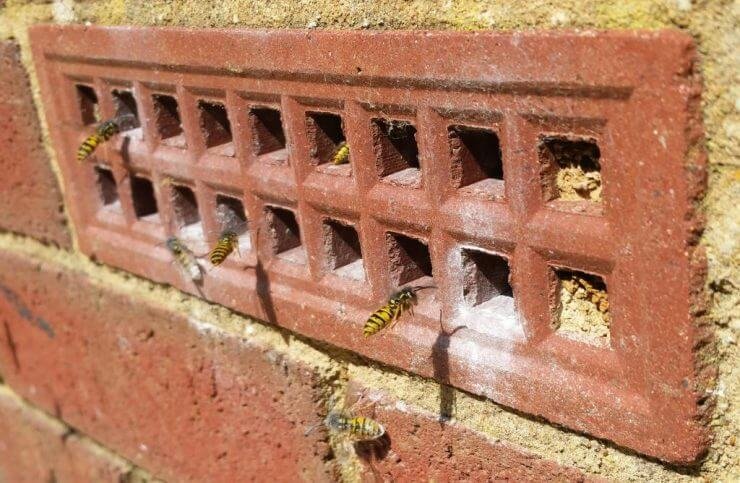
Airbricks and external wall vents are a classic wasp entry point — particularly the red clay airbricks on inter-war and 1950s-60s Hertfordshire housing. The nest itself is in the sub-floor or wall void behind it, and treatment is delivered straight through the vent from outside.
How to confirm it's a nest, not just foraging
A real outdoor-vent nest gives itself away by a steady two-way flight line — wasps arriving heavy and leaving light through the same one or two holes in the airbrick. The activity peaks mid-morning and mid-afternoon on warm days. Look for:
| Sign | What it means |
|---|---|
| Constant traffic through one or two holes in the airbrick | Active nest in the void behind the vent. The wasps have committed to a single entry route. |
| Other holes in the same airbrick unused | Normal — wasps stick to the route closest to the nest cells. |
| Faint chewing / rasping sound at the wall on a still evening | Workers building combs inside the void. Confirms the nest is close to the vent. |
| Dark staining around the vent holes | Resin and bodily oils from heavy traffic. A sign the nest has been there several weeks. |
| Wasps inside the house at skirting boards or under floorboards | The void is connected to living space. Treat the vent urgently — do NOT block it. |
Why outdoor vents are such a wasp magnet
Airbricks vent the sub-floor void of a suspended-timber ground floor (low-level vents) or a wall cavity (vents higher up the wall). Both voids are dry, dark, sheltered from rain and birds, and stay a stable temperature year-round — exactly what a spring queen wasp is looking for to start a colony. The original purpose of the vent (controlling damp) makes it impossible to permanently block, so the same airbricks get re-used by new queens year after year.
What NOT to do
- Don't block the vent with foam, mesh or a brick — see the callout above.
- Don't spray a shop-bought aerosol into the vent. The mist disperses in the void and never reaches the nest. It also makes the wasps defensive without killing the colony.
- Don't pour petrol, bleach or boiling water in. Dangerous, illegal, and the colony survives anyway.
- Don't stand close to film it. The flight line is a direct route; standing in it provokes defensive stings.
How we treat a nest behind an outdoor vent
- Confirm the active hole. Usually obvious within 30 seconds of arrival.
- Powder applied directly into the vent with a long-reach applicator from outside. Nothing is opened up; the airbrick stays in place.
- Wasps carry the powder onto the comb as they walk through it, killing the colony — including the queen — within hours.
- Activity stops within 2-4 hours; colony fully dead by the next morning.
- Leave the vent open for 7-10 days so foragers returning to the nest also pick up the powder. After that the vent can be screened with a fine stainless mesh (not blocked) if you want to stop reuse next year.
- Free revisit guarantee if any activity returns.
Related guides
- Wasp nest in a wall cavity
- Wasp nest in soffits or eaves
- Wasp nest in a loft
- Wasp nest removal cost
- Hertfordshire coverage areas