
Wasp Behaviour
When Do Wasps Sleep? And When Is It Safe to Approach a Nest?
Wasps do not sleep the way we do, but they do have a daily cycle of activity and rest that determines when a nest is safest — and most dangerous — to be near. Here is the honest picture from a working pest controller.
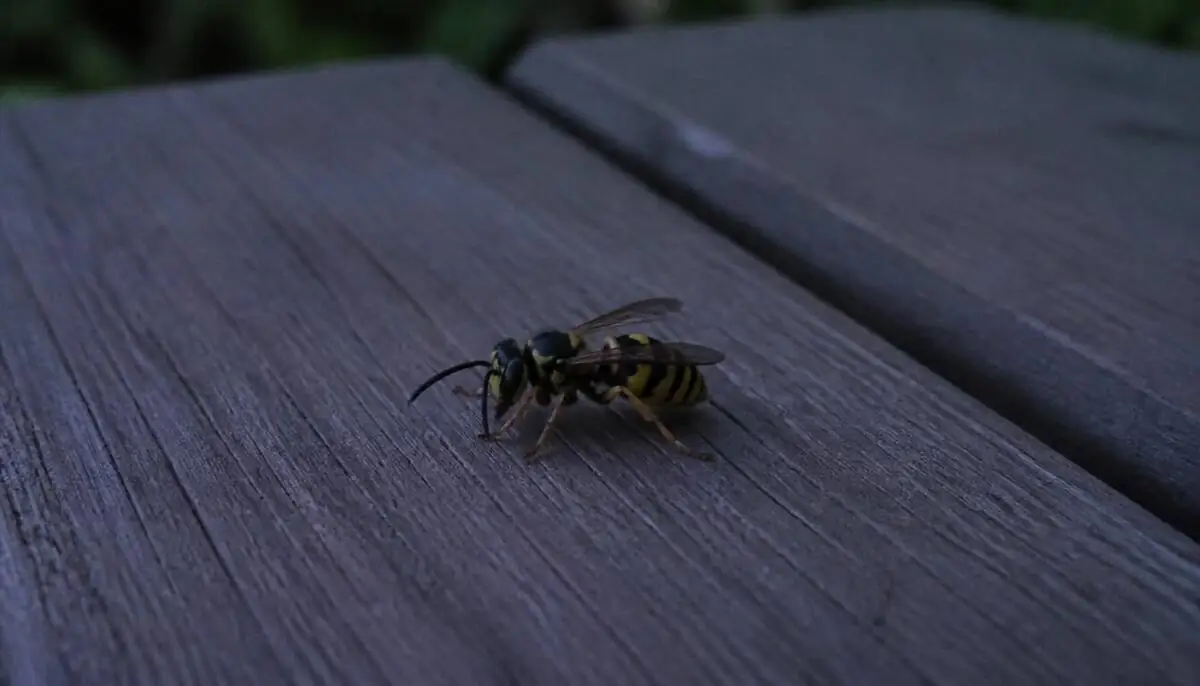
- Wasps enter a prolonged rest state from roughly one hour after sunset until just before sunrise.
- Activity stops when temperatures fall below about 10°C or in full darkness.
- Almost all workers are inside the nest overnight — disturbing it then provokes a far larger response than during the day.
- Wasps fly directly toward any bright light after dark. Never shine a torch into a suspected nest entrance.
- Professional treatment is normally carried out in daylight, not at night.
Do wasps sleep?
Not in the way mammals do. Insects do not have the same sleep architecture, but social wasps (Vespula vulgaris and Vespula germanica — the two species responsible for almost every UK nest) do show a circadian rest cycle. Workers stop foraging when light levels drop below a threshold they can navigate by, return to the nest, and remain almost completely still through the night. Heart rate, antennal movement and response to stimuli all reduce.
What that means in practice is that a wasp nest at 2am contains virtually the entire worker population, packed inside, motionless but instantly responsive if disturbed. A nest at 2pm has 30–60% of its workers out foraging at any moment.
The two thresholds: light and temperature
Wasp activity is gated by two independent thresholds, and both have to be met for normal foraging.
Temperature: wasps cannot fly effectively below about 10°C. On a cool morning in May or September, you will see no traffic at a nest entrance until the air warms — often well after sunrise.
Light: common and German wasps are diurnal. They need daylight to navigate. As light fades in the evening, returning workers go inside and outgoing trips stop. European hornets are the exception — they will continue flying after dark and are strongly attracted to lit windows.
Hour-by-hour activity in a UK summer
| Time of day | What the nest is doing |
|---|---|
| Pre-dawn (4–5am) | Almost all workers inside. No outgoing flights. Nest temperature maintained by clustering. Disturbance produces a large, concentrated defensive response. |
| Early morning (6–8am) | First scouts leave once air temperature reaches roughly 10°C. Traffic builds gradually. A cool morning can delay this to 9am or later. |
| Mid-morning to mid-afternoon (9am–4pm) | Peak foraging. Continuous two-way traffic at the entrance. Up to 60% of workers may be out at any moment. The nest is at its most dispersed. |
| Late afternoon (5–7pm) | Foraging tapers as light fades. Workers return faster than they leave. Entrance traffic still visible but decreasing. |
| Dusk (8–9pm) | Last returns. Final stragglers arrive within roughly an hour of sunset. Outgoing trips have effectively stopped. |
| Night (10pm–4am) | All workers inside. No flight activity unless artificial light or vibration disturbs the nest. Wasps that do leave are strongly drawn to any nearby light source. |
Why night-time DIY treatment is so dangerous
It seems intuitive — wait until the wasps are asleep, then deal with the nest. In reality, three things make night the worst time for an untrained person to approach a nest.
1. The whole colony is home. Any disturbance triggers a response from every worker in the nest, not the fraction that happens to be present in the day.
2. Wasps fly to your light. A phone torch, head torch or porch light becomes the brightest object in their world. Disturbed wasps fly straight at it — and at the person holding it.
3. You cannot see what you are doing. Reading wasp behaviour at the entrance, judging the right distance, and having a clear exit route all require daylight. None of that is possible by torchlight.
So when do professionals treat nests?
The honest answer surprises most people: nearly all our treatments are carried out in normal daylight hours. The insecticide we apply at the entrance leaves a residual deposit, so every returning forager picks up a lethal dose on its way back in. We do not need the whole colony to be present at the moment of treatment.
Where dawn or dusk visits are useful, we use red-filtered light (which wasps see very poorly) and approach from outside the flight path. That is a long way from a homeowner with a phone torch and a can of supermarket spray.
What about European hornets?
European hornets are the one exception worth knowing about. They forage at dusk and continue well into the night, and they are strongly drawn to lit windows. If you have a hornet nest nearby, close curtains at night and avoid leaving outdoor lights on close to the suspected location. See our European hornet guide for the full picture.
Related guides
- The wasp life cycle
- When do wasps die off?
- Can I remove a wasp nest myself?
- Signs of a wasp nest
- Our treatment process